
Software Developer
Software developers design, build, test and improve digital products and systems. They spend time understanding problems, breaking them into smaller parts, building solutions, testing what works, and communicating with other people.
Best explored around ages 12–17
What software developers actually do
A closer look at the real work, day to day.
- Understand a user or business problem
- Break a large problem into smaller pieces
- Design how a feature should work
- Write or modify code
- Test different scenarios
- Debug when something goes wrong
- Review other people's work
- Explain decisions to teammates
- Improve existing systems
Typical tasks
- Fix a bug
- Design a new feature
- Review user feedback
- Test an app
- Improve performance
- Discuss trade-offs
- Document a solution
What this kind of work can involve
These describe the work itself — not a personality type or who belongs in it.
Solving unclear problems
Creating something that works
Testing and improving ideas
Working independently
Collaborating with a team
Paying attention to detail
Working through frustration
Common misconceptions
Myth
Developers spend all day typing code.
Reality
A lot of the work involves understanding problems, planning, testing, debugging and communicating.
Myth
You have to be a math genius.
Reality
Different software roles use different amounts of math. Logical thinking, curiosity and persistence often matter more day to day.
Myth
You work alone with headphones on.
Reality
Most developers work with designers, product managers and other developers, and spend real time discussing trade-offs.
Fix the School Club App
A school club app is creating duplicate registrations and not clearly showing when signup succeeds.
About how long
30–60 min
The themes it touches
Debugging · Problem solving · Testing
What the mission involves
- understanding the problem
- finding possible causes
- choosing a fix
- testing different scenarios
- explaining your solution
Afterwards, you'd reflect on questions like
- “Do you enjoy turning an unclear problem into steps?”
- “Do you like testing and improving something you built?”
- “Do you enjoy finding why something isn't working?”
- “Do you like balancing different possible solutions?”
These are for reflection only. There are no right answers, no score, and nothing that labels you.
A parent signs in and approves the session before the mission begins.
Career access is included with paid Family Premium — $9.99/month or $79.99/year, per family.
Build a Simple Activity Recommender
If the mission clicked, this is a longer project where you build and test a real prototype from scratch. It takes more time and asks more of you — that’s the point.
About how long
2–5 hours · done across several sittings
How it's different from the mission
You build the whole thing, test it, and improve it — not just one guided task.
What the project involves
- Design what your tool asks and what it can suggest
- Build the rules that turn answers into a recommendation
- Test it with different cases and improve something you find
- Explain your design and reflect on how it went
A parent sets up the session, just like a mission. There's no score or grade — finishing the build and reflecting on it is what matters. Your work stays private to your family.
Career access is included with paid Family Premium — $9.99/month or $79.99/year, per family.
Where and how they work
Careers are not isolated job titles — the setting, people and tools vary widely.
Where and how they work
- Technology companies
- Banks
- Hospitals
- Game studios
- Government
- Startups
- Research organizations
Who they work with
- Product managers
- Designers
- Other developers
- Customers / users
- Data teams
- Business teams
Tools they may use
- Code editors
- Version control
- Issue trackers
- Testing tools
- Design / collaboration software
Skills that come up
These are related skills and subjects — not a checklist you need to master to belong here.
Skills involved
- Problem decomposition
- Logical thinking
- Communication
- Attention to detail
- Persistence
- Testing
- Creativity
Related school subjects
- Computer science
- Math
- Design
- Writing / communication
How people get into this work
People enter software development through different routes, including university degrees, community college, technical programs, self-directed learning, projects and professional experience. There is no single required path.
An honest picture
The parts that can be hard
Every kind of work has friction. Knowing it up front is part of exploring honestly.
- Working through bugs that take time to understand
- Changing requirements
- Detailed testing
- Long periods of focus
- Explaining technical decisions
Try it in real life
Activities that touch this kind of work
These are real activities from RungMark's discovery library — a low-stakes way to see if the work feels interesting.
 Technology
Junior Game Coding
Frisco Code Studio
Design and code your own playable games, one project at a time.
 STEM
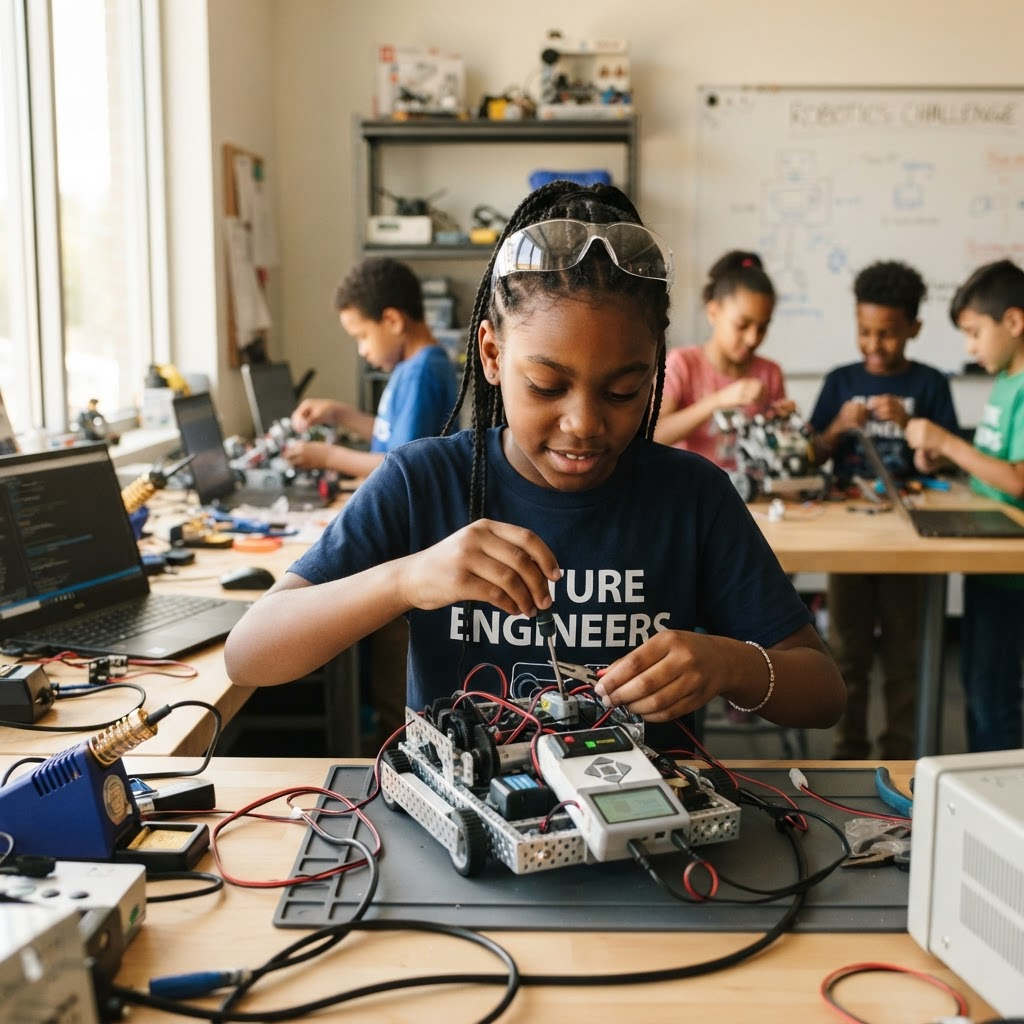
STEMBuild & Battle Robotics
North Dallas Robotics Lab
Build a working robot, test designs and compete in friendly challenges.
 STEM
STEMLittle Scientists Lab
Frisco Discovery Center
Playful hands-on experiments that spark early curiosity about how things work.
Making & BuildingMaker Garage Workshop
Allen Makerspace
Design, prototype and build real projects with tools and 3D printers.
Exploring alongside a child
When you have an account, career curiosity connects to your child’s Growth journey: reflections on activities they actually try, so patterns emerge honestly over time.
Where this comes from
This overview is written and reviewed by the RungMark team to stay balanced and current. It focuses on the nature of the work rather than any single employer or path.
- RungMark editorial review (illustrative mock content) — Mock placeholder — public occupational descriptions to be cited before publication.
Last reviewed August 2026
Keep exploring
Other kinds of work to look at
Exploring widely is the point. There's no wrong direction here.
Digital Content Creator
Plan, produce and improve content that reaches and helps a specific audience.
Common work
- Understanding an audience
- Turning an idea into a clear message
- Producing something on a schedule
- Editing and refining work
Mission: Create a Campaign for a Community Event
Physician / Healthcare Professional
Use scientific thinking, observation and communication to help people stay healthy.
Common work
- Scientific thinking
- Careful observation
- Clear communication
- Empathy
Mission: Help a Community Health Team